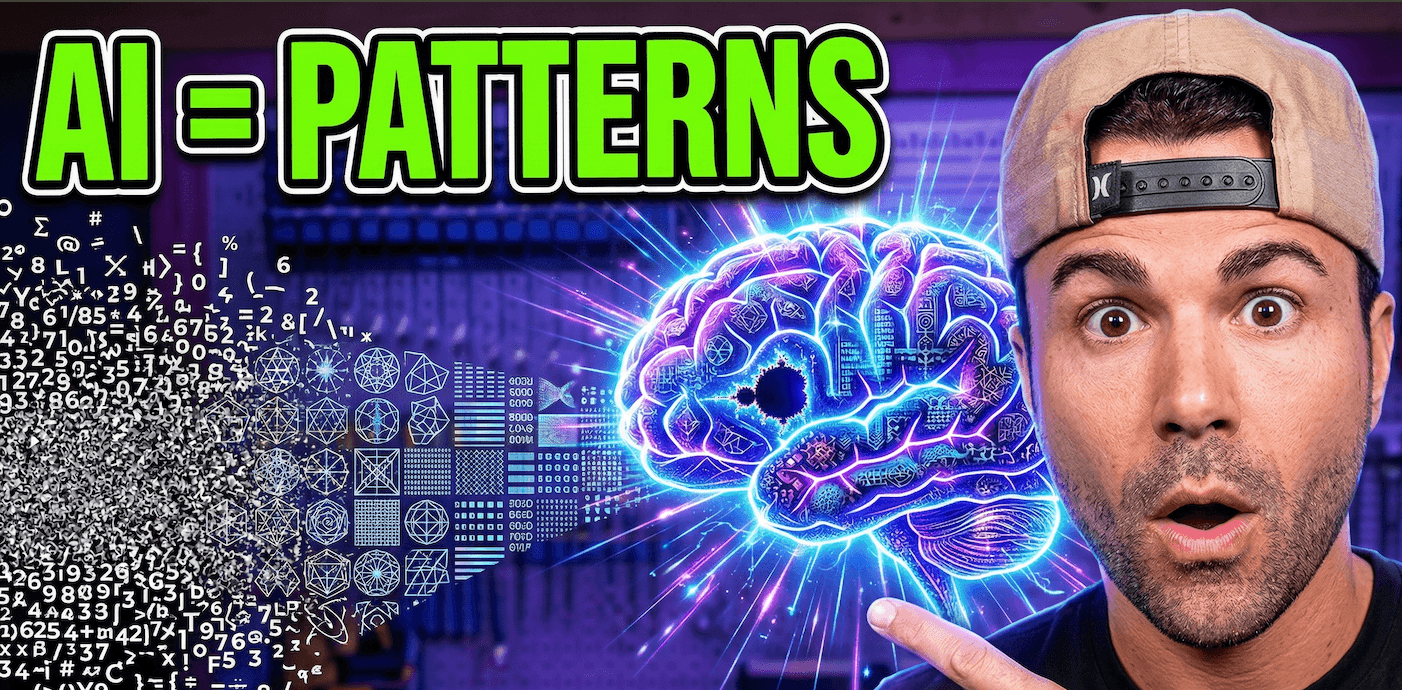


Most People Misunderstand AI
Most people think AI is becoming intelligent.
It’s not.
It’s becoming better at recognizing patterns.
That distinction matters more than anything else.
Because if you think AI “thinks,” you’ll use it wrong.
If you understand patterns, you’ll unlock it.
This is where most explanations fail.
They anthropomorphize the system.
They describe behavior instead of mechanism.
And when you misunderstand the mechanism, you lose control of the output.
What AI Actually Is
AI is not reasoning in the human sense.
It is not conscious.
It is not aware.
It is a system trained to detect, predict, and reproduce patterns in data.
Text.
Images.
Behavior.
Decisions.
Code.
Voice.
Everything it outputs is based on patterns it has seen before.
This isn’t a limitation.
It’s the entire advantage.
Because patterns scale.
Humans struggle to hold thousands of variables in memory.
AI doesn’t.
It compresses them into relationships.
And relationships are what drive prediction.
The Paradigm Shift
Old model: Intelligence = reasoning
New model: Intelligence = pattern recognition at scale
Humans reason slowly with limited data.
AI processes massive datasets and identifies patterns instantly.
Humans search for meaning.
AI searches for correlation.
You don’t need AI to “understand.”
You need it to recognize what repeats.
Patterns Are the Interface to Intelligence
If you want better outputs from AI, the lever isn’t more prompting tricks.
It’s pattern clarity.
Because AI doesn’t respond to intent.
It responds to structure.
It doesn’t interpret what you meant.
It extends what you gave it.
When you give vague input, you provide weak patterns.
When you give structured input, you provide strong patterns.
You don’t talk to AI.
You feed it patterns.
The Pattern Stack
1. Language Patterns
How ideas are structured.
- Clear vs vague phrasing
- Ordered vs scattered thoughts
- Specific vs generic wording
AI mirrors the structure you give it.
Not just the words.
The hierarchy.
Garbage in isn’t just bad data.
It’s broken structure.
2. Context Patterns
What surrounds the request.
- Who the audience is
- What the goal is
- What constraints exist
- What has already been decided
Without context, AI guesses.
With context, AI aligns.
Context reduces entropy.
It narrows the probability space of possible outputs.
3. Outcome Patterns
What “good” looks like.
- Tone
- Format
- Depth
- Style
- Constraints
- Success criteria
If you don’t define the outcome, AI defaults to averages.
And averages are where quality dies.
The Hidden Layer: Feedback Patterns
There is a fourth layer most people ignore.
Feedback patterns.
AI improves when you refine the pattern loop.
- Adjust structure
- Tighten constraints
- Reinforce what worked
- Remove what didn’t
This creates compounding improvement.
Not because the AI changed.
Because your pattern design did.
How It Actually Works Underneath
AI models are trained by predicting the next piece of data in a sequence.
Next word.
Next pixel.
Next token.
Next action.
Over time, they learn statistical relationships between elements.
Not meaning.
Not truth.
Relationships.
This is the mechanism:
Patterns → Probabilities → Predictions → Outputs
The better the pattern, the tighter the probability distribution.
The Compression Effect
AI doesn’t store knowledge the way humans do.
It compresses patterns into dense representations.
This is why AI can generalize.
And also why it can hallucinate.
Because it operates on likelihood, not certainty.
The Behavioral Shift
Before:
You searched for answers.
Now:
You shape outputs.
The skill is no longer finding information.
It’s structuring inputs.
This is a cognitive upgrade.
Not a technical one.
Strategic Implications
If you understand patterns:
- You reduce iteration time
- You increase output quality
- You create repeatable systems
- You standardize thinking
If you don’t:
- You rely on luck
- You blame the tool
- You stay average
Weak operators hope AI works.
Strong operators design inputs that guarantee it works.
Why Now
- Massive data availability
- Cheap computation
- Accessible interfaces
Pattern recognition didn’t just improve.
It became usable.
The Second-Order Effect
The real divide won’t be technical.
It will be cognitive.
People who think in patterns will outperform those who think in prompts.
Because prompts are tactics.
Patterns are systems.
And systems compound.
The Real Unlock
AI is a mirror.
It reflects the structure of your inputs.
Which means:
It reflects the structure of your mind.
Food for thought
If AI is only as good as the patterns it receives:
What patterns are you feeding it?
And more importantly:
Are you building systems…
Or just generating outputs?
