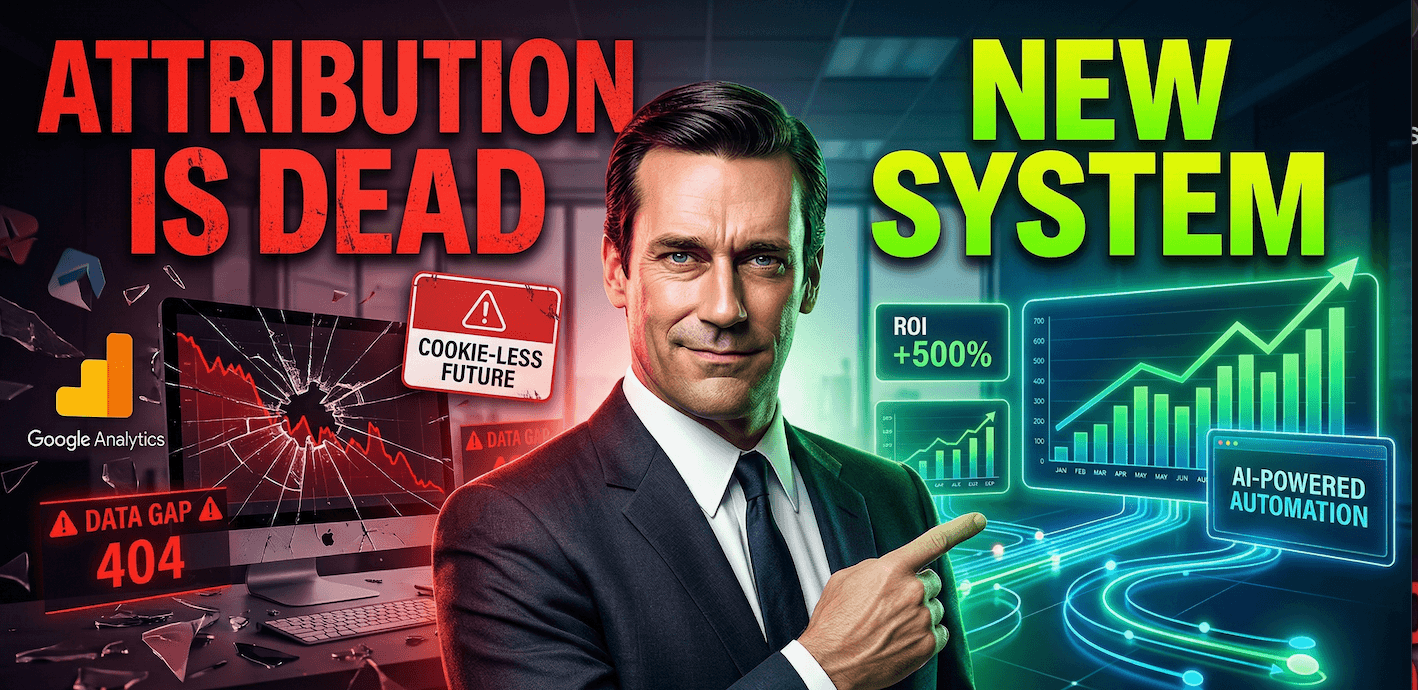


The Misframing
The market thinks attribution is breaking because of privacy.
That’s not true.
Attribution is breaking because it was never structurally sound to begin with.
Privacy didn’t break attribution.
It removed the illusion that it ever worked cleanly.
What you’re seeing now isn’t decay.
It’s exposure.
“Attribution didn’t decay. It was always an approximation pretending to be truth.”
And most teams built their entire growth strategy on top of that approximation.
What Attribution Actually Is
Attribution is a compression layer.
It takes:
- Non-linear behavior
- Multi-touch influence
- Time-delayed decisions
And forces it into:
A single causal event
That simplification is not a feature.
It’s the flaw.
Because reality doesn’t collapse cleanly.
It overlaps, compounds, and loops.
So when you force it into a linear model, you don’t just lose accuracy.
You lose causality.
Category Reinterpretation
Attribution is not measurement.
It’s a translation system.
And like any translation:
It removes nuance to create clarity
The problem is:
The more complex the system becomes,
the more aggressive the simplification needs to be.
Eventually, what you’re left with:
Looks precise
But is directionally misleading
That’s where most operators get trapped.
They mistake clean dashboards for clean truth.
The Paradigm Shift
Old model:
Attribution = truth → optimize channels
New model:
Attribution = signal → optimize system
This is not a small adjustment.
It changes the unit of optimization entirely.
From: “Which channel performs best?”
To: “Which system configuration produces the highest probability of conversion over time?”
The Demand Accumulation Engine
Marketing does not create conversions.
It creates conditions where conversion becomes inevitable.
This is the Demand Accumulation Engine.
This is not a campaign.
It’s not a funnel.
It’s a system that builds decision readiness over time.
Layer 1: Exposure
Function: Create familiarity before intent exists
Mechanism: Repeated exposure reduces cognitive resistance
It builds something attribution cannot measure:
Memory density
No one converts here.
But almost no one converts without it.
Layer 2: Intent
Function: Validate decisions already forming
Mechanism: Users seek certainty, not discovery
At this stage, influence has already happened.
Attribution just shows up late and claims ownership.
Layer 3: Conversion
Function: Remove final resistance
Mechanism: Clarity, speed, and ease
This is where attribution feels strongest.
And that’s exactly why it’s misleading.
Where Attribution Breaks
Attribution tries to answer a question it cannot support:
“Which layer caused the conversion?”
But conversions are not caused.
They are released.
They are the result of pressure building across the system.
Distortion #1: Layer Collapse
Top-of-funnel disappears.
Bottom-of-funnel gets overvalued.
Distortion #2: Time Compression
Weeks of influence get credited to seconds of action.
Distortion #3: Platform Bias
Each platform reports its version of truth.
Mechanism-Level Truth
Conversion is threshold-based.
It happens when:
Perceived value exceeds perceived risk
That margin is built over time.
Not in a single interaction.
Marketing’s job:
- Increase perceived value
- Decrease perceived risk
- Repeat until the threshold is crossed
Behavioral Insight
Humans don’t remember touchpoints.
They remember:
- Familiarity
- Trust
- Recognition
So when they convert, they don’t think:
“This ad worked.”
They think:
“This feels like the right choice.”
Strategic Implications
Most companies optimize what is measurable.
Not what is causal.
This leads to:
- Overinvestment in conversion channels
- Underinvestment in awareness
- Rising acquisition costs
The Replacement System
Probabilistic Growth Modeling
This replaces certainty with signal.
1. Blended Metrics
- Blended CAC
- MER
2. Incrementality Testing
Measure impact by removing variables.
3. Leading Indicators
- Branded search
- Direct traffic
- Engagement velocity
4. Conversion Lag
Measure time between first exposure and purchase.
Why Now
- Privacy is reducing tracking accuracy
- Platforms are fragmenting journeys
- Users require more exposure to decide
The system became more complex.
The measurement stayed simple.
Second-Order Insight
As attribution weakens:
Advantage shifts to better thinkers, not better tools.
This creates a divide:
- Teams that optimize dashboards
- Teams that design systems
Food for thought
If attribution was never fully accurate…
Why are you still using it as truth?
And if conversions are the output of accumulated certainty…
Where in your system are you actually creating it?
